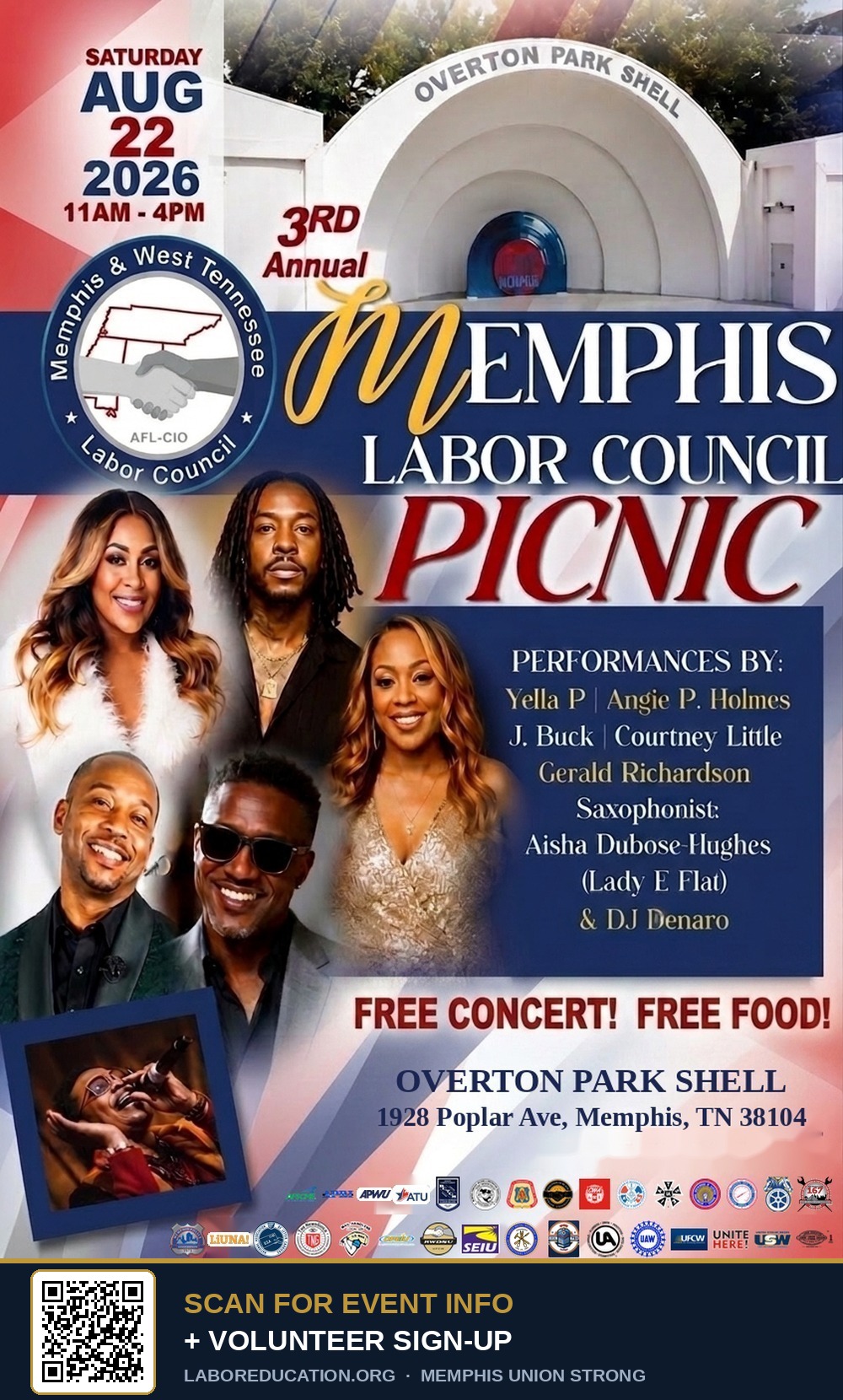
3rd Annual Memphis Labor Council Picnic
Free Concert · Free Food · Overton Park Shell
Bayard Rustin
1912 — 1987
Trained Dr. King in Gandhian nonviolence. Organized the 1963 March on Washington in ten days. Lived openly as a Black gay man at a time when both targeted him for arrest, beatings, and erasure — and stayed in the work anyway.
“We need, in every community, a group of angelic troublemakers. Our power is in our ability to make things unworkable.”
— Bayard Rustin
Biography
Bayard Rustin was born in West Chester, Pennsylvania in 1912 and raised by his Quaker grandmother. He was openly gay decades before that was survivable. He was a draft resister during World War II and served 28 months in federal prison rather than register. He was a member of the Fellowship of Reconciliation and an early member of the Congress of Racial Equality.
In 1955 he traveled to Montgomery, Alabama and met a 26-year-old Baptist pastor named Martin Luther King Jr. who was reading Reinhold Niebuhr but did not yet know Gandhi. Rustin spent six months teaching him. The Montgomery Bus Boycott became a Gandhian campaign because Rustin made it one. Every nonviolent strategist who came after — Lawson, Diane Nash, John Lewis, James Bevel — sat at some point at Rustin's elbow.
In the summer of 1963, A. Philip Randolph called him. The march Randolph had been threatening since 1941 was finally on. Rustin had ten days to organize 250,000 people, 2,000 buses, 21 chartered trains, food and water and bathrooms and a sound system on the Lincoln Memorial steps. He delivered. The March on Washington for Jobs and Freedom went off without a single arrest.
His sexuality made him a target his entire life. Strom Thurmond stood on the floor of the U.S. Senate and read Rustin's morals-charge arrest record into the Congressional Record to try to destroy the march. Randolph refused to fire him. The march went on.
In 1965 he co-founded the A. Philip Randolph Institute, which pushed the labor-civil rights alliance from inside the AFL-CIO for the next four decades. He died in 1987 still organizing.
President Obama awarded Rustin the Presidential Medal of Freedom in 2013 — fifty years to the month after the march he had organized.
What they built that we still stand on
Trained Dr. King in Gandhian nonviolence (1955-56)
Six months in Montgomery, teaching King the philosophical and tactical foundations of the method that would carry the Civil Rights Movement.
Organized the 1963 March on Washington
Ten days. 250,000 people. Zero arrests. The largest logistical operation in the history of American protest at the time.
Co-founded the A. Philip Randolph Institute (1965)
The institutional spine of the Black labor-civil rights coalition for the next half century.
Built the moral case for coalition politics
Rustin's 1965 essay 'From Protest to Politics' shaped the strategy that elected the first generation of Black mayors, congressmembers, and union presidents.
Lived openly as a Black gay man in public life
Decades before that was survivable. The fact that he kept his seat at the table at all changed the table.
Presidential Medal of Freedom (posthumous, 2013)
Awarded by President Obama. Accepted by Rustin's partner of 10 years, Walter Naegle.
Rustin's method came to Memphis through his student James Lawson — the man Dr. King called to lead the 1968 Sanitation Workers Strike. Every disciplined nonviolent action in this city, from the Mall through the present day, runs on a method Rustin taught Lawson taught us.
Further study
Primary sources by and about Bayard.
Brother Outsider: The Life of Bayard Rustin — Trailer
The official trailer for the 2003 PBS Independent Lens documentary that finally put Rustin's full story on screen — the Quaker pacifism, the prison years, the strategy of nonviolence, the Black gay life lived openly under hostile fire, and the ten-day organizing of the 1963 March on Washington.
Hosted on YouTube by kweliTV. Play in-line above, or watch directly on YouTube.
Pre-filled message: “Watch kweliTV's tribute to Bayard Rustin — "Brother Outsider: The Life of Bayard Rustin — Trailer" — on the Memphis & West TN CLC Labor Education site.”
Keep going — other resources on Rustin
Every part of him was the work.
Bayard Rustin lived openly as a Black gay man at a time when both identities were criminalized, demonized, and routinely deployed to destroy careers. In 1953 he was arrested in Pasadena on a morals charge that haunted him for decades. In 1963 Senator Strom Thurmond stood on the U.S. Senate floor and read that arrest record into the Congressional Record to try to break the March on Washington.
Randolph refused to fire him. The march went on.
Every modern Bayard Rustin organization — beginning with the Bayard Rustin Center for Social Justice — centers his queer leadership as inseparable from his civil-rights work. Anyone teaching Rustin without that lens is teaching half a man. We honor the whole.
"I always felt that the gay community had a contribution to make to the human-rights movement. We are all of one piece. There is no liberation that isn't a liberation of every part of us."
HISTORICAL ARCHIVE
Bayard Rustin — in the work.


Historical photographs of Bayard Rustin used on this page are sourced from the U.S. Library of Congress (public domain) where available, and from Wikimedia Commons public-domain releases. Archive inquiries, image rights, and licensing for non-public-domain materials are directed to the Bayard Rustin Center for Social Justice — rustincenter.org — and its BRCSJ Queer History Archive stewarded with Walter Naegle.
FROM RUSTIN'S 1965 ESSAY TO YOUR 2026 BALLOT
From Protest to Politics — the strategy still working.
In 1965, after the Voting Rights Act passed, Rustin published "From Protest to Politics" arguing that protest alone could not deliver power without electoral and coalitional organizing on the other side. That essay shaped the strategy that elected the first generation of Black mayors, congressmembers, and union presidents. This app's Civic Power Playbook and Tennessee Voter Power Hub are the direct intellectual descendants of that essay — strategy + action, exactly as Rustin laid it out.
PARTNERS · KEEPERS · TEACHERS
Stewards of the Legacy
The institutions and people actively carrying Bayard Rustin's name, archive, and method into the present. Visit them. Donate. Volunteer. Cite their work.
Bayard Rustin Center for Social Justice
The principal active organization carrying Bayard Rustin's name and method into the present — civil rights, LGBTQ+ liberation, restorative justice, voter engagement.
A. Philip Randolph Institute (APRI)
Co-founded by Randolph and Rustin in 1965. The institutional spine of the Black labor / civil-rights coalition for the past 60 years. Memphis chapter is on this app.
BRCSJ Queer History Archive — Walter Naegle, steward
Walter Naegle was Rustin's partner of ten years and has long managed his estate and legacy. The Bayard Rustin Center for Social Justice now hosts the dedicated queer-history archive for Rustin's writings, images, and papers.
Brother Outsider — The Life of Bayard Rustin
The definitive on-screen biography directed by Nancy Kates & Bennett Singer. Used as the educator-source film for the Rustin Method workshop on this page.
The Rustin Method
A 6-page lesson plan for community teachers, history & civics educators, library facilitators, and faith-class leaders. Includes lesson agenda, primary-text excerpts, discussion questions, role-play exercises, FAQ, and sources.
The Rustin Method — 45-Minute Educator's LessonFree. No signup. Print and share. Suitable for high-school and college classrooms, community-center lessons, library facilitators, and faith-class educators.
The torch is still in Memphis hands.
The institution Rustin built has a working leader in Memphis right now. The chain is unbroken because the chair is filled.
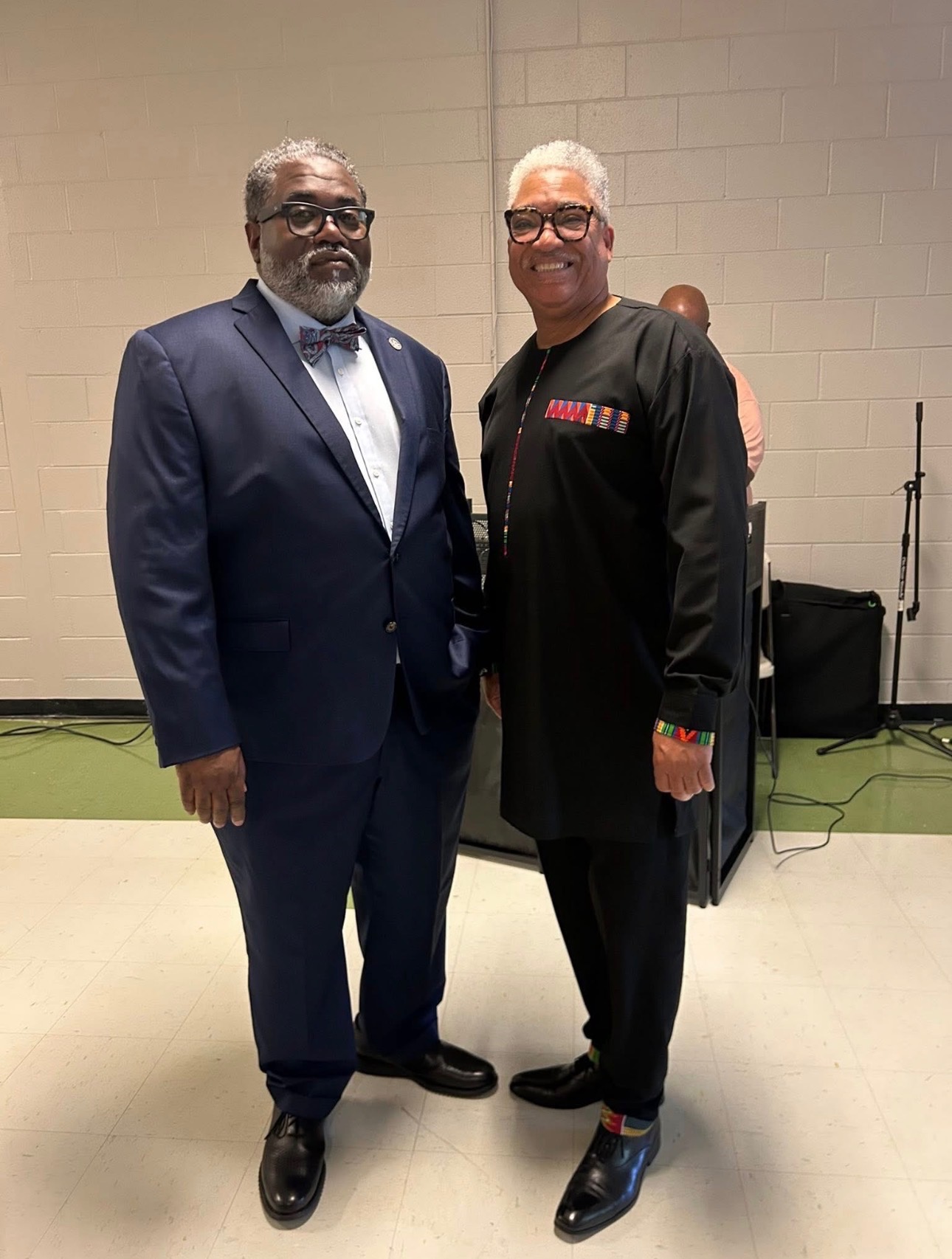
Kermit Moore
Rustin's institutional heir in Memphis. As co-founder of APRI alongside Randolph in 1965, Rustin built the labor-civil-rights coalition's institutional spine. Kermit Moore now holds that chair in Memphis, presiding over APRI Memphis and the NAACP Memphis Branch simultaneously.
Kermit Moore (right) with President Kevin Bradshaw
Rustin — Knowledge Check
Five questions. Score 4 or higher to claim a printable certificate honoring your study of Bayard Rustin.
Keep reading: Memphis strike history from 1968 to now
Struggle & Solidarity: Labor Strikes in Memphis (1968-Present) — a free eBook by President Kevin Bradshaw walking through every major Memphis labor fight from the sanitation strike to today's picket lines.
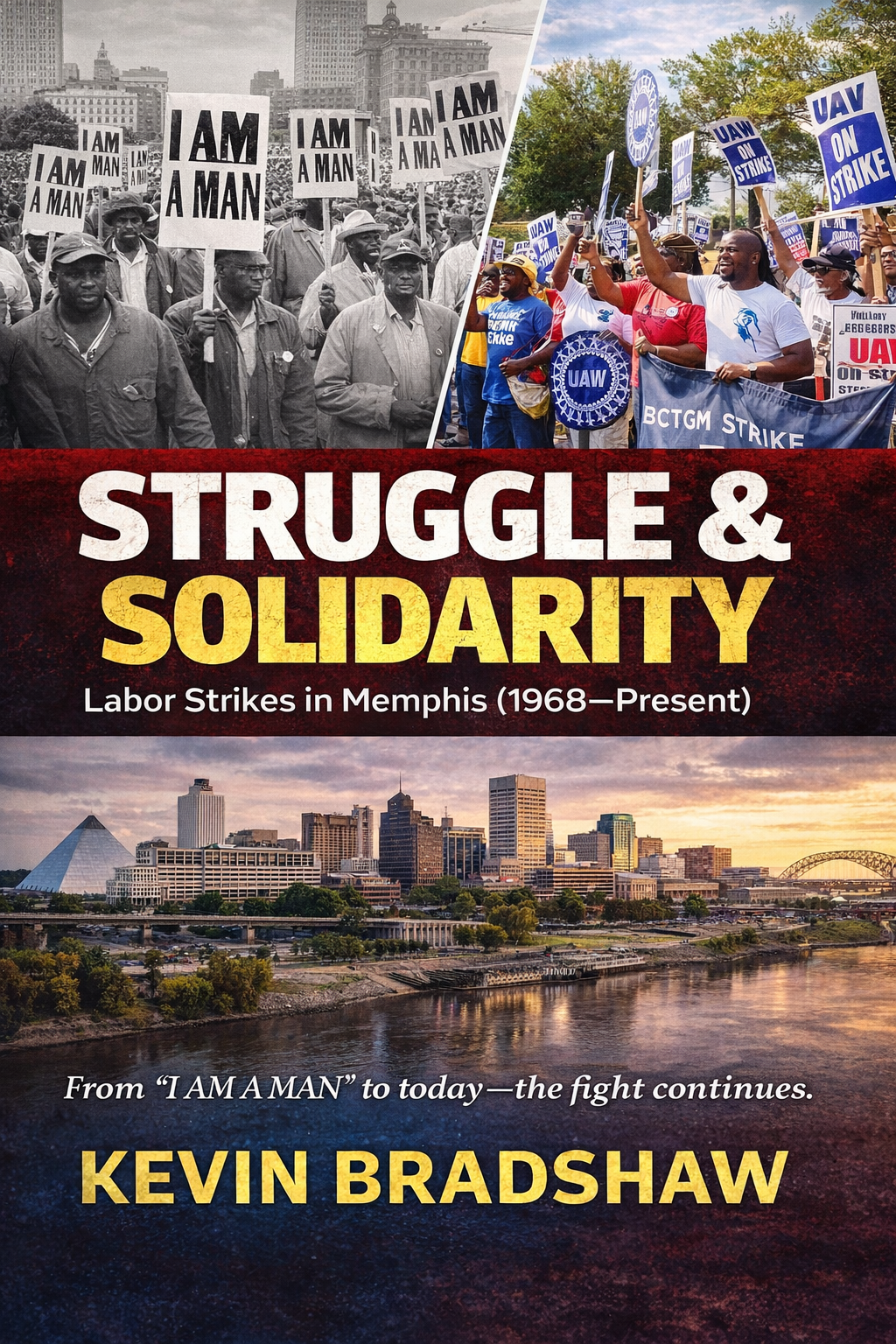 Read the free eBook
 Translate