
Worker Mental Health & Wellbeing
The job can take a lot from you. It does not get your mind.
Burnout, forced overtime, a death on the line, an injury that changed everything, a supervisor who will not let up — and for retirees, a quiet house after forty years of noise. Working people carry it silently and call it toughness. There is help, some of it already paid for by your own contract, and asking for it costs you nothing.
Help right now, any hour
You do not have to be suicidal to call any of these. “I am not doing well and I do not know what to do” is reason enough.
988 Suicide & Crisis Lifeline
Call or text 988Free and confidential, 24/7. Press 0 to reach a local crisis counselor. Veterans press 1.
More informationCrisis Text Line
Text HOME to 741741
If you would rather type than talk. A trained counselor, free and private.
More informationTennessee Statewide Crisis Line
855-CRISIS-1 · 855-274-747124/7/365. Can dispatch mobile crisis to you and connect you to treatment near home.
More informationAlliance Healthcare — Memphis & Shelby Mobile Crisis
901-577-940024/7 local crisis line and mobile dispatch. Walk-in Crisis Wellness Center, 3200 Broad Ave, Memphis 38112.
More informationIf someone is in immediate danger, call 911 and ask for a Crisis Intervention Team (CIT) officer by name. CIT officers are trained for mental health calls. Say the words when you call — it changes who shows up.
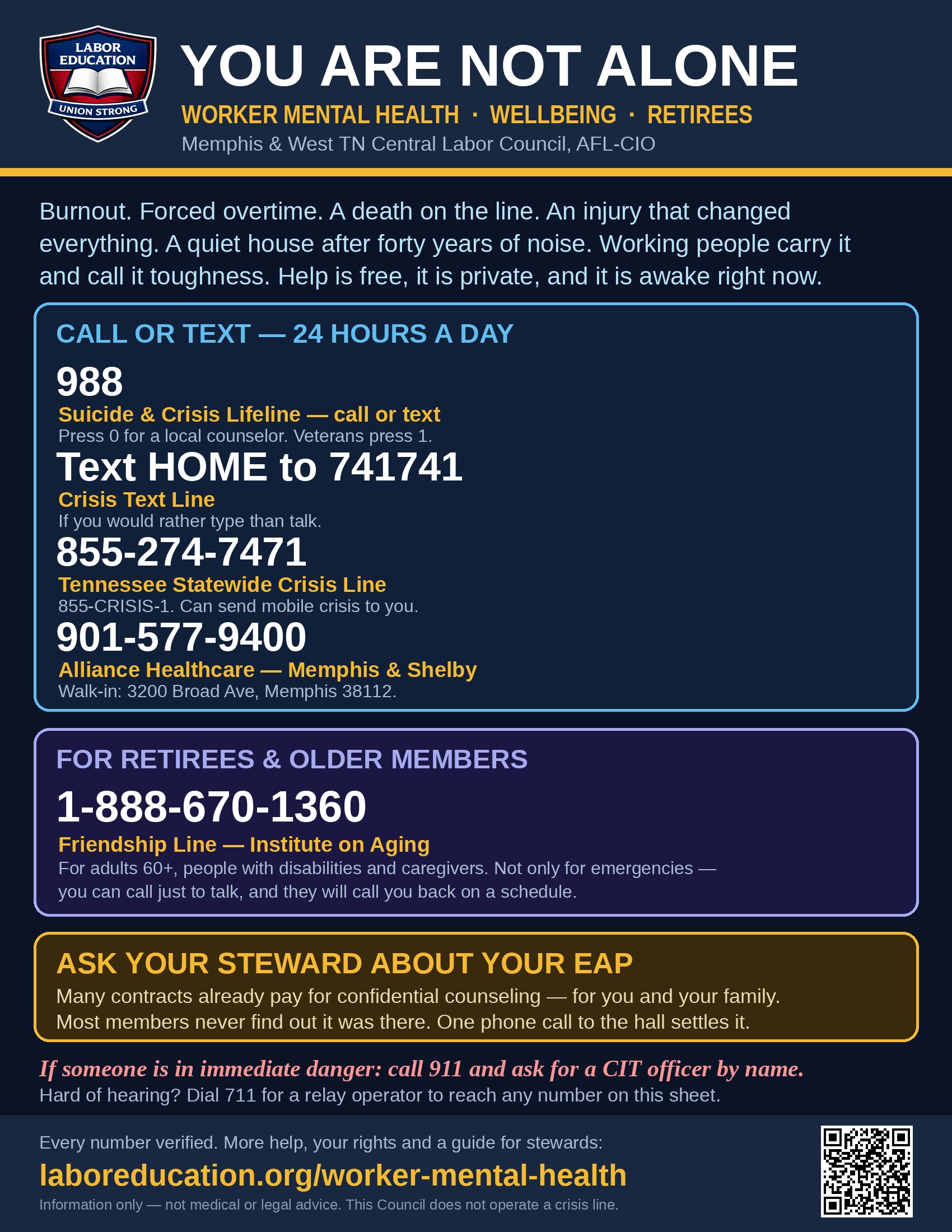
Print it · Post it · Hand it out
One page. Every number that answers.
Put it on the board at the hall, in the break room, in a new-member packet. Letter size, black-and-white friendly, with a QR code back to this page.
What the job actually does to people
None of this is weakness. These are working conditions, and conditions can be changed — at the table, in a grievance, and in how we look after each other.
Mandatory overtime
Sixty and seventy hour weeks are not a personality flaw you have to out-tough. Chronic forced overtime is a known driver of burnout, and it is a bargaining issue, not just a personal one.
Shift work and sleep
Rotating shifts and nights wreck sleep, and wrecked sleep looks exactly like depression and anxiety. If you feel like a different person on nights, you are not imagining it.
A death on the job
Losing a co-worker is grief and trauma at once, and the plant usually reopens the next morning. Ask about a critical incident debrief. Do not let the company treat it like a schedule problem.
After an injury
Pain, light duty, fighting over a claim, and the fear you will never be the same worker again. The anxiety that comes with an injury is part of the injury.
Harassment and bullying
A supervisor who singles you out wears a person down a day at a time. Document it, tell your steward, and do not carry it alone.
Layoffs and money
A closing, a cutback or short hours puts fear in the whole house. Financial strain and mental health are the same conversation.
Retirees & older members
Nobody is checking on the old-timers
Men 75 and older have the highest suicide rate of any male age group in the country — 40.1 per 100,000 in 2024, roughly three times the national rate. They are also the least likely to call anybody about it.
Source: CDC / NCHS Data Brief 572A retiree who worked forty years is still a member. The hall still owes him a phone call. If you have a retiree chapter, this is the work: call the list, show up, ask the second question.
The day the badge stops working
Thirty years of being the one who knew how to run that line, and then a Friday. Retirement takes the paycheck, but it also takes the crew, the routine and the title — and nobody warns you that it feels like grief.
Burying your people
Spouses, brothers and sisters off the floor, the ones you came up with. Loss stacks up faster at this age than anyone acknowledges out loud.
A body the trade used up
Knees, backs, shoulders, lungs, hearing. Chronic pain and depression feed each other, and a working life leaves a bill that comes due late.
Caring for a spouse
Dementia and long illness turn a husband or wife into a full-time caregiver with no shift change and no relief. Caregivers get sick too.
Fixed income, rising everything
Watching a pension or a Social Security check buy less every year is its own kind of dread — and it is not a character flaw to be frightened by it.
Four walls and quiet
When driving stops, the world shrinks to the house. Isolation is a health condition, not a preference, and it is the one most likely to go unnoticed.
Lines built for older adults and their families
The Friendship Line is the one most people have never heard of — you do not have to be in crisis to call it. Loneliness is reason enough, and they will keep calling you back.
Friendship Line — Institute on Aging
1-888-670-1360 · 24/7
Built for adults 60+, adults with disabilities and caregivers. A crisis line AND a warmline — you can call just to talk, and they will call you back on a schedule if you want. Spanish 1-888-571-0411 · Korean 1-888-560-7684.
More informationAging Commission of the Mid-South
901-222-4111
The local Area Agency on Aging — meals, transportation, in-home help and benefits counseling for Shelby, Fayette, Lauderdale and Tipton. 160 N Main St, 3rd Floor, Memphis.
More informationAlzheimer's Association Helpline
800-272-3900 · 24/7, every day
Live staff for dementia questions, crisis help and local resources — for the person diagnosed and for whoever is caring for them.
More informationEldercare Locator
1-800-677-1116 · Mon–Fri, 9am–8pm ET
A federal service that finds aging services anywhere in the country — useful when a parent lives in another state.
More informationTN SHIP — free Medicare counseling
1-877-801-0044
Unbiased help with Medicare coverage, including what it pays for behavioral health. Locally the Aging Commission handles SHIP.
More informationHard of hearing? Dial 711 for a relay operator, who can connect you to any number on this page. Medicare covers behavioral health care, including an annual depression screening — TN SHIP above can tell you exactly what your plan pays for.
You may already have this
How to find your union's EAP or Member Assistance Program
A lot of members are paying for counseling they have already bargained for. An EAP or MAP is a benefit, the same as your health plan or your pension — and most people never find out it was there until somebody tells them. Work these in order.
- 1
Ask your steward or business agent first
They know if the local has a Member Assistance Program, who runs it and whether calls stay private. One phone call usually settles it.
- 2
Look in your contract
Check the benefits article of your CBA. Many agreements name an EAP, an MAP or a counseling benefit outright.
- 3
Check your health plan and benefit fund
Many union health and welfare funds cover behavioral health visits and pay for a set number of counseling sessions, sometimes at no cost to you.
- 4
Call HR or the benefits line on your insurance card
If there is an EAP, HR has the number. The back of your insurance card also lists a behavioral health line.
- 5
Ask how confidentiality works before you talk
Most EAPs do not report what you discuss to your employer. Ask anyway, in plain words, and get the answer before you share anything.
- 6
Ask what it covers for your family
Plenty of EAPs cover a spouse and children too, and cover more than counseling: grief, money troubles, substance use, legal help.
No union where you work? The crisis lines above are free to everyone, and the Tennessee REDLINE and TDMHSAS helpline below can route you to care regardless of insurance.
What your contract and the law may cover
General information, not legal advice. Talk to your steward or business agent before you file anything — your contract may give you more than the law requires.
Leave for a serious condition
The federal FMLA can cover leave for a serious mental health condition for eligible workers. The U.S. Department of Labor publishes guidance on how it applies.
DOL — FMLA & mental healthAccommodation at work
The ADA can require reasonable accommodations for a mental health condition. The EEOC explains what workers can ask for and what employers may ask you.
EEOC — your legal rightsBring your steward
If you are called into a meeting you reasonably believe could lead to discipline, you have the right to union representation. Ask for your steward before the meeting starts, not after.
For stewards and officers
When a member is not okay
You are not a therapist and nobody expects you to be. You are the person they already trust enough to talk to, and that is the part no professional can do for you.
Do
- · Ask twice. The first answer is almost always "I'm fine."
- · Listen longer than feels comfortable. You do not need the right words.
- · Ask directly if you are worried someone is thinking of suicide. Asking does not plant the idea.
- · Walk them to the phone and sit with them while they call.
- · Follow up in a few days. The check-in after the crisis is the one people remember.
Don't
- · Do not diagnose, and do not repeat what they told you around the hall.
- · Do not promise to keep a secret if someone's life is at risk.
- · Do not make it a grievance before you make it a conversation.
- · Do not leave someone alone who is in immediate danger. Call 988 or 911 and ask for a CIT officer.
Licensed in Tennessee
Counselors you can call in Memphis
Check your EAP first — it often covers the first sessions at no cost. If you would rather go outside the plan, or your plan has none, these clinicians practice here in Memphis.
Elnora Peters, LPC-MHSP
Centergy Behavioral Health
Offers reduced-rate sessions through the Open Path Collective.
Call (901) 329-3662Listed as a public resource from the clinician's own published profiles. This Council is not paid for the listing, takes no referral fee, and does not supervise or endorse anyone's care. You can confirm any Tennessee license yourself at the state's license verification site.
More help in Tennessee
Tennessee REDLINE
1-800-889-9789 · call or text, 24/7
Confidential referrals for substance use and problem gambling, run by TAADAS for the state.
OpenTDMHSAS Helpline
800-560-5767 · Mon–Fri, 8:00am–4:30pm
Not a crisis line. Help navigating Tennessee mental health and substance use services.
OpenNAMI Greater Memphis
901-213-6107
Not a crisis line. Family support groups, education and advocacy in the Memphis area.
OpenNAMI National HelpLine
1-800-950-6264 · Mon–Fri, 10am–10pm ET
Information and referrals for you or a family member.
OpenAlso on this platform
Safe Haven
Domestic violence, sexual assault and survivor resources — English and Spanish.
Stand Strong
Bullying support for kids, teens and adults.
Health 360°
Our founding wellness partner — whole-person care, union group discount.
Caregivers
For members looking after someone else.
This page is information for working people and their families, gathered from the organizations named above. It is not medical or legal advice, and this Council does not operate a crisis line. Phone numbers and hours were verified when this page was published — if something has changed, the organization's own website is the authority.
 Translate